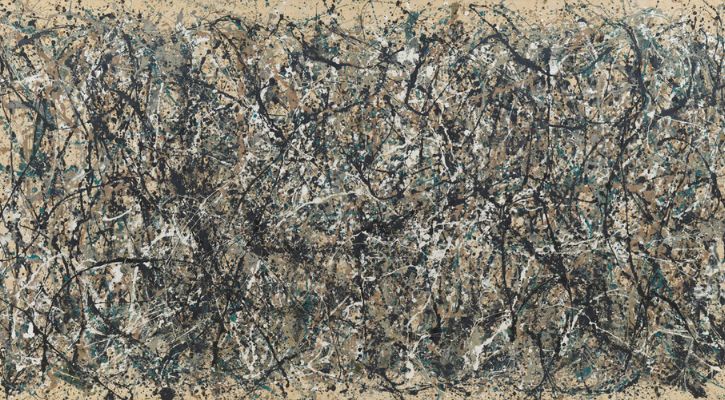
On my most recent trip to New York, I had the chance to spend time with several works by one of my favorite artists, Jackson Pollock. Both the MoMA and the Met house some of his most significant paintings, including Autumn Rhythm, No. 31, and No. 1A.
Standing in front of a Pollock is a very different experience from looking at most other paintings. There is no image to decode, no apparent order, no privileged point of view from which the work suddenly makes sense. What the visual chaos of the painting conveys are the artist’s gestures and a kind of absolute anarchy of the work in relation to its author. The eye gets lost, moves back and forth across the canvas, and every area demands attention in the same way.
Pollock painted with the canvas laid out on the floor, moving around it and throwing paint using sticks, brushes, or by letting it drip directly from the can. This way of working is known as action painting, and through it he shifted painting from the plane of representation to the plane of action. More than a finished result, what one encounters when looking at a Pollock is evidence of something that happened, and that, in some way, is still happening.
His paintings do not convey a closed idea or a specific emotion. They convey exposure, risk, and a certain renunciation of control over the work. It is as if the meaning of the painting were not given from the outset, but instead appeared as the process unfolded. The canvas is not the representation of a predefined image; it is the result of a succession of gestures and decisions that continuously alter the outcome and demand an immediate response in order to continue.
Action Before Understanding
In Ex Machina, there is a key scene that captures the core idea of the entire film. Caleb begins to question not only Ava’s behavior, but the very method by which she has been created. He tries to find a clear connection between Nathan’s intention and the result of his creation. At that point, Nathan asks Caleb what would have happened if Jackson Pollock had stopped before starting, saying: “I can’t paint anything unless I know exactly why I’m doing it.” Caleb replies that, in that case, Pollock never would have made a single mark.
The line is not really about painting. It points to something more fundamental: the impossibility of creating (of building intelligence, in that context) if we demand total understanding before acting.
The scene suggests that some forms of creation require accepting a certain initial opacity. Pollock is not presented as an artist without criteria, but as someone whose work could not have existed if he had demanded full clarity before beginning.
From this perspective, Pollock’s way of working becomes easier to understand. Each drop of paint changed the state of the canvas and required a response: to move forward, correct, insist, or stop. It was not a linear process, but a recursive and iterative one. Painting was, for Pollock, a way of observing. He acted in response to what was happening on the canvas until the process reached a certain internal coherence and stabilized.
All of this points to a simple idea: in many complex creative processes, understanding is generated through action. Knowledge becomes, at times, a byproduct of sustained doing. Trying to fix the goal of a work too early can impoverish the process instead of guiding it.
## Meaning Appears Late
At this point, it is hard not to connect this shift in how knowledge is generated with the way many digital products are built today.
To understand Pollock’s creative process is to understand the need to expose a product to the world: to launch incomplete versions, functional prototypes, deliberately fragile systems that exist only to be put in contact with real use. There are aspects of the problem a product is trying to solve that reveal themselves only when someone actually interacts with what has been built.
A large part of learning in product development happens when users use a system in unexpected ways, when certain features take on an unforeseen centrality, or when others, designed to be useful, turn out to be irrelevant. In many products, what they really are is discovered late.
From this perspective, many successful products are not the faithful execution of an initial idea, but the result of an ongoing negotiation with reality. Each iteration changes the product and, at the same time, the team’s understanding of it. Knowledge is generated as a direct consequence of doing.
This logic was later formalized in approaches such as those proposed by Eric Ries, who describes product development as a continuous loop of action, measurement, and learning, where knowledge is produced through contact with reality.
Working this way inevitably generates discomfort, because it requires giving up the sense of control that planning and early clarity provide. Yet that discomfort, born of uncertainty, is a necessary condition for creating something that is not fully defined from the outset.
Accepting Uncertainty
In Ex Machina, Nathan understands intellectually that consciousness, and, by extension, complex systems, cannot be designed line by line. He knows that something emerges that cannot be fully anticipated. That is why he invokes Pollock as an example. But this understanding does not translate into a genuine acceptance of the consequences of the process he has set in motion.
Nathan clings to the idea that he still occupies an external, dominant position with respect to what he has created. He needs to prove that he controls it. He confuses authorship with understanding, and understanding with dominance. While Pollock submits to the process of painting, always acting in response to what is happening on the canvas, Nathan wants the process to unfold without calling his own position into question.
The difference matters. Pollock does not merely accept that he does not fully know what he is doing; he also accepts being guided by the process, being forced to correct, insist, or stop. Nathan, by contrast, tolerates uncertainty only as long as it does not threaten his sense of control. Emergence is acceptable as an idea, but not as an experience.
When uncertainty is eliminated too early, what is lost is not only flexibility, but the capacity to learn. The product stops being a space of discovery and becomes the rigid execution of a hypothesis that is no longer being tested. Any deviation on the part of the user is interpreted as an error, not as information.
Letting It Happen
There is a constant temptation, especially in technical, creative, or strategic contexts, to confuse clarity with progress. To believe that moving forward means reducing uncertainty as quickly as possible, fixing meanings, closing options. Yet both in Pollock’s work and in the complex systems we build today, understanding rarely precedes action.
Accepting this does not mean romanticizing chaos or abandoning responsibility. It means recognizing that there are moments in a process when trying to understand everything in advance is counterproductive, moments when the only way to discover what we are building is to sustain the act of doing long enough for something to start responding.
Perhaps the real risk is not acting without knowing exactly what we are doing, but refusing to act until we feel that we do. If Pollock had waited to fully understand his painting before starting, he would not have painted a single mark. One can’t help but wonder how many things we fail to build today for the very same reason.